×

The Standard e-Paper
Stay Informed, Even Offline
 The Standard Group Plc is a
multi-media organization with investments in media platforms spanning newspaper
print operations, television, radio broadcasting, digital and online services. The
Standard Group is recognized as a leading multi-media house in Kenya with a key
influence in matters of national and international interest.
The Standard Group Plc is a
multi-media organization with investments in media platforms spanning newspaper
print operations, television, radio broadcasting, digital and online services. The
Standard Group is recognized as a leading multi-media house in Kenya with a key
influence in matters of national and international interest.

Audio By Vocalize
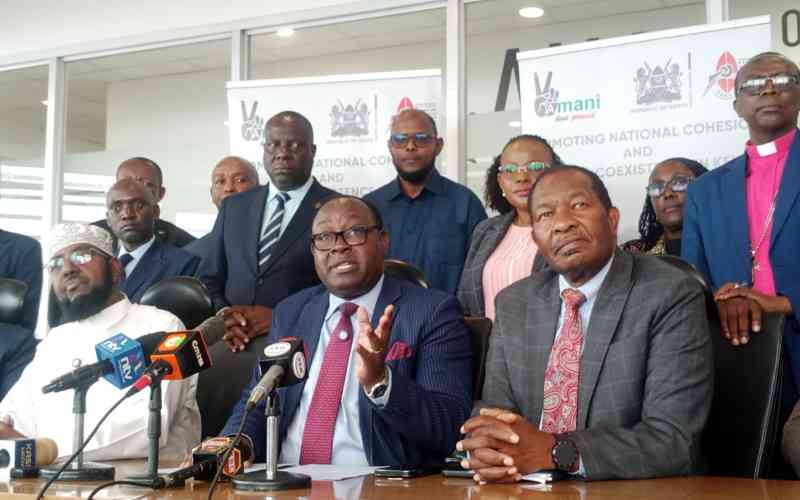
When the National Cohesion and Integration Commission (NCIC) announced yesterday that it had opened investigations into former Deputy President Rigathi Gachagua, Health Cabinet Secretary Aden Duale and eight other public figures over alleged hate speech and ethnic incitement, the statement carried a familiar tone.
No one, the Commission declared, is above the law. Investigations were underway. Evidence was being gathered. Cases would only proceed to court once investigators had assembled watertight files.
It is a message Kenyans have heard repeatedly over the past 19 years.
Since its establishment in 2008 following the post-election violence that left more than 1,100 people dead and displaced hundreds of thousands, the NCIC has routinely warned politicians against inflammatory rhetoric, convened peace meetings, issued cautionary statements and summoned leaders accused of violating the National Cohesion and Integration Act.
Yet as the country edges closer to another election cycle, the same questions continue to surface: has the Commission become a respected constitutional watchdog, or has it gradually evolved into an institution known more for warnings than enforcement?
This week's announcement followed growing public outrage over remarks by Health Cabinet Secretary Aden Duale during a community empowerment event in Lafey Constituency, Mandera County.
Speaking in his local dialect, Duale praised President William Ruto's administration for integrating the Somali community into mainstream national affairs, citing the removal of extra vetting for national identity cards and major infrastructure projects in northern Kenya. He then accused a section of Kenyans of believing that no other community should prosper in the country.
"They have said that nobody else will live well in Kenya except them. They have said Kenya belongs to them and that no one else should prosper in this country, not even people like Moses Wetang'ula,’’ Duale said.
The remarks ignited criticism across the political divide, eventually reaching the Senate, where lawmakers condemned them as divisive and inconsistent with the responsibilities of a Cabinet Secretary.
But what followed raised fresh questions about the authority of the NCIC.
Rather than immediately responding to the Commission, Duale publicly challenged it.
He declared that he would only honour an NCIC summons if former Deputy President Rigathi Gachagua was summoned alongside him.
"The day I appear before the NCIC, Rigathi Gachagua must appear alongside me. I will go with my lawyers, and Rigathi should also come with his lawyers," Duale said.
He went further, insisting that Gachagua was the country's leading offender when it came to hate speech and warning that he would ignore any summons if the former Deputy President was excluded.
Stay informed. Subscribe to our newsletter
For critics, the exchange exposed a deeper problem.Instead of fearing the Commission's authority, politicians increasingly appear willing to negotiate with it publicly, challenge its decisions or even dictate the terms under which they will cooperate.
That perception is not new. Every election cycle has been accompanied by NCIC press conferences, appeals for restraint, interfaith peace campaigns and warnings against hate speech. Yet ethnically charged political rhetoric has remained a recurring feature of Kenya's politics through the 2013, 2017, 2022 and now the emerging 2027 election campaigns.
The Commission insists the criticism overlooks the realities of criminal investigations.
NCIC Chairman Kepha Nyamweya defended the agency's approach this week, saying investigations cannot be based solely on viral social media clips.
"We have launched investigations. These investigations take time. We go to the field, gather information and properly document it because by the time we go to court, we must have a watertight case," he said.
Nyamweya said the Commission first establishes the authenticity of digital evidence before taking action, particularly at a time when artificial intelligence can generate convincing fake videos.
"We don't know whether the clip that has been sent is AI-generated. We have to be sure that it is a legitimate complaint. By the time we call upon any political actor, we must have evidence,’’ he said.
He also rejected suggestions that NCIC only acts after political pressure, insisting the Commission follows legal procedures rather than public sentiment.
"We don't wait until a political leader issues a statement or takes on NCIC for us to act. We act following the due process of the law and the procedures. This commission is going to act firmly without fear or favour."
Those explanations, however, have done little to quiet criticism from governance and communication experts who argue that consistency, rather than process alone, determines public confidence.
Communication scholar Dr Hesbon Owilla argues that Kenya still needs an institution dedicated to national cohesion because politics remains largely organised around ethnic identities.
"I think ethnic profiling, ethnic inflammation and ethnic incitement are a very big problem in Kenya because our political mobilisation is along ethnic lines," he said.
According to Owilla, ethnic mobilisation is not inherently dangerous until leaders begin portraying other communities as enemies or obstacles to development.
"The problem begins when leaders move from mobilising their own communities to creating animosity against other communities. That is where ethnic profiling and incitement begin, and that is what the Commission exists to stop,’’ Owilla said.
But he believes the Commission's greatest challenge is not its constitutional mandate but the manner in which that mandate has been exercised.
"The problem is not the constitutional institution. The problem is the office holders," he said.
He argues that constitutional commissions are designed to function independently of political influence and that public confidence is weakened when politicians openly challenge the Commission's decisions or appear to influence its actions.
"If another politician is reminding the Commission that you can only summon me after summoning someone else, what does that tell you? It tells you they failed from inception,’’ he said.
Owilla said the Commission should have developed and consistently applied clear operational standards for investigating hate speech, making it easier for Kenyans to understand why particular statements warrant investigations while others do not.
"It should not be politicians deciding who deserves to be summoned. Kenyans should know what conduct requires investigation,’’ he added.
Political analyst Ian Horsefield said the National Cohesion and Integration Commission (NCIC) has failed to live up to its constitutional mandate, arguing that political interference has rendered it largely ineffective. While the commission was established to promote national cohesion and curb hate speech, he said its independence is often undermined by political interests.
"I don't think there is anything the public should expect from NCIC. These are constitutional commissions that are well established through Acts of Parliament, and on paper they are very flowery. The motive behind them was very good. But in practice, there is nothing that they do,’’ he said.
Horsefield noted that the absence of serious hate speech prosecutions since the commission's establishment reflects its poor enforcement record. Drawing a parallel with the Independent Policing Oversight Authority (IPOA), he cited President William Ruto's directive seeking to place the watchdog under the Executive. He noted that the move was halted after Maalim and Associates Advocates successfully challenged it in court.
"The court stopped the directive, saying you cannot give an institution a mandate to check itself. It defeats the logic of checks and balances,’’ he asserted.
The criticism reflects a broader concern that has followed the NCIC for years.
Despite regularly identifying inflammatory political statements, the Commission has struggled to convince many Kenyans that there are real consequences for violating cohesion laws. High-profile summons have often generated headlines, but far fewer cases have resulted in convictions that fundamentally alter political behaviour.
The Commission's defenders argue that successful prosecutions depend not only on investigations but also on the quality of evidence, prosecutorial decisions and judicial outcomes. Critics counter that regardless of the legal hurdles, the absence of visible enforcement has weakened the institution's deterrent effect.
Meanwhile, the political environment is becoming increasingly volatile.
As political alliances shift and campaigns gather momentum ahead of the 2027 General Election, inflammatory rhetoric is once again finding its way into public discourse.
Nearly two decades after the Commission was created to ensure that the horrors of the 2007-08 post-election violence are never repeated, the challenge facing the NCIC may no longer be explaining its mandate.
It is demonstrating that it possesses both the independence and the resolve to enforce it consistently, regardless of the political stature of those under investigation.





Subscribe to our newsletter and stay updated on the latest developments and special offers!








 join
join