
 The Standard Group Plc is a multi-media organization with investments in media
platforms spanning newspaper print
operations, television, radio broadcasting, digital and online services. The
Standard Group is recognized as a
leading multi-media house in Kenya with a key influence in matters of national
and international interest.
The Standard Group Plc is a multi-media organization with investments in media
platforms spanning newspaper print
operations, television, radio broadcasting, digital and online services. The
Standard Group is recognized as a
leading multi-media house in Kenya with a key influence in matters of national
and international interest.


KNUNM Deputy Secretary General Maurice Opeto, Chairperson Ngwasi John and Treasurer Maureen Nzioka address a press briefing in Nairobi. [Wilberforce Okwiri, Standard]
When Jecinter Muthoni began preparing for the birth of her baby, she already knew where she wanted to deliver.
The 27-year-old businesswoman, who sells plastics and lives in Baba Dogo, had planned to deliver at Mama Margaret Kenyatta Hospital, the nearest public facility to her home. She had saved what she could, expecting the money to be enough for delivery in a public hospital.
But two weeks before her due date, the nurses' strike began, turning the public hospital she had planned to rely on into a source of uncertainty.
“I had been planning and had even decided that I would deliver at Mama Margaret Kenyatta but when I heard about the strike, I developed fear because I knew it would interfere with services, which it did,” Muthoni said.
With the public hospital no longer a reliable option, she began looking for an affordable private facility. She visited three hospitals to compare prices before settling on one she believed she could manage, with the hope that family and friends would help if the bill became too much.
She went in expecting a normal delivery but was instead rushed into theatre for an emergency Caesarean section.
- Hospitals struggle to cope as nurses strike disrupts services
- Nurses' strike enters crucial week as SRC, CoG meetings offer possible breakthrough
- Gynecologists have raised alarm over nurses strike as maternal care suffers
- High Court orders striking nurses back to work
Keep Reading
The unexpected procedure pushed the cost of care higher, forcing Muthoni to use all her savings to settle the bill, with friends and chama members also stepping in to help.
“I used up everything that I had saved to clear the bill and thank God my friends and chama members also came through with some cash helping me foot the bill,” she said.
Still recovering with her one-week-old daughter, Muthoni requested an early discharge because she knew that staying longer would mean a higher bill.
Her experience captures the cost of a nurses' strike that has stretched into weeks. Nurses have maintained that they will not return to work until their grievances are addressed, even as counties move to take action against striking medics.
The dispute has left patients dealing with disrupted services, huge medical bills after visiting private hospitals and in some areas, facilities operating with severely reduced capacity.
In Mombasa, more than 800 nurses remain off duty, with the union maintaining that there will be no return to work until the long-standing Collective Bargaining Agreement is signed, Universal Health Coverage nurses are given permanent and pensionable letters and Career Progression Guidelines are implemented.
Talks involving union officials, the Salaries and Remuneration Commission and a government-appointed conciliator have so far failed to break the deadlock, leaving nurses away from their workstations.
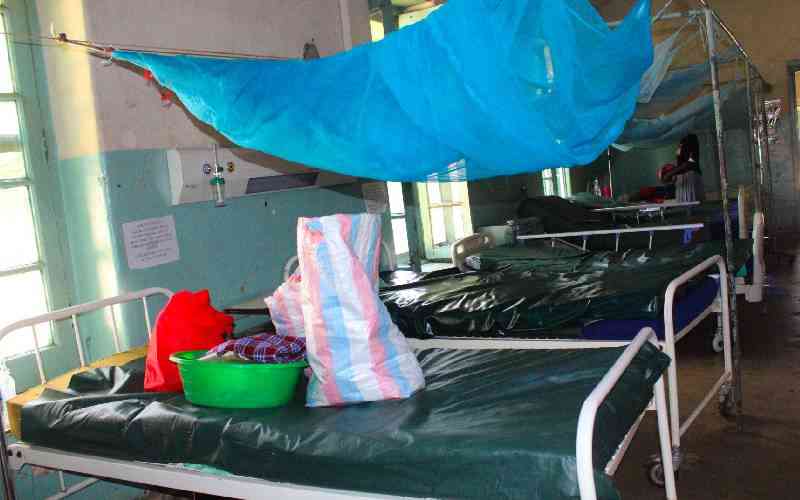
Empty beds at Kisumu County Referral Hospital as nurses’ strike continues. [Rodgers Otiso, Standard]
Nurses have also continued to demonstrate and march every Thursday to Delta House and vowed to keep returning until their demands are addressed.
“We will report here at the Council of Governors offices every Thursday until they listen to us. We will not get tired,” said KNUNM Deputy Secretary-General Maurice Opetu.
The Council of Governors, however, has maintained that the strike is illegal and previously directed county service boards to take action against workers who fail to report to duty.
At least three counties, including Mombasa, Murang'a and Nyandarua, have initiated disciplinary action against striking health workers, with some moving to replace staff to bridge gaps created by the strike.
But as the two sides maintain their positions, the effects are being felt inside public hospitals.
In Homa Bay, most public health facilities have remained shut, according to a report from the county. At Homa Bay County Referral Hospital, most wards, including maternity, were not operating, with only two wards continuing to provide services with support from a non-governmental organisation and a few county-employed workers.
The disruption is also being felt in Siaya, where all Level Two and Level Three hospitals have reportedly remained shut. At Level Four facilities including Madiany, Bondo and Yala, services have been limited to critical cases, with the county relying on nurses engaged on a locum basis.
The arrangement has allowed some essential services to continue but only on a limited scale as the strike keeps regular nursing staff away from their workstations.
For patients requiring regular care, the disruption has created another problem: Finding alternatives they can afford.
Jane Adhiambo, a diabetic patient from Ngong', normally attends her medical outpatient clinic once a month, with her scheduled appointment falling on a Thursday.
When she went for her appointment last week, she found the hospital unusually empty.
“I was so shocked to find the hospital halls empty, the place that is always mostly full of people, especially on clinic days,” she said.
Her routine checks, including blood pressure, weight and blood glucose monitoring, could not be done because the nurses who normally triage patients were on strike.
Student nurses were present on rotation, but Adhiambo said she was uncomfortable being attended to without the supervision she normally receives from qualified nurses.
She returned home without receiving her scheduled clinic care but with her blood sugar levels having risen above normal, she later sought care at a private facility.
She spent Sh6,000 on consultation and Sh1,600 on medicines, an unexpected Sh7,600 expense.
Adhiambo relies on SHA and has no other medical insurance to cushion her against the additional cost.
The strike has also disrupted healthcare workers themselves.
Gabriel Kivai, a Medical Officer Intern at a public facility in Mombasa, said he has had to put his internship training on hold because nurses are central to his clinical training and work.
“The strike has forced me and my fellow interns to hold our internship training because the nurses are mostly the ones we learn from and work with hand in hand,” he said.
Kivai said inpatient and outpatient services have been affected, with some patients being transferred to private facilities.
Although other medical officers have continued reporting to work, he said their ability to provide services is limited by the absence of nurses.
“The other medical officers are trying, but they can hardly operate without nurses.Most aftercare services are done by the nurses,” he said.
The disruption has therefore extended beyond the nurses' employment dispute, affecting patients who rely on public facilities, healthcare workers trying to provide services and medical trainees whose clinical work depends on functioning hospital teams.
For Muthoni, the strike meant abandoning a delivery plan she could afford and finding money for private care at short notice.
She remains grateful that she and her daughter are safe but says the prolonged dispute should not leave patients carrying the burden.
“I think nurses really help a lot in these hospitals and I think it's only fair they get what they've worked for,” she said.
But she worries most about women and other patients who have nowhere else to turn.
“All this dragging is just affecting us patients, people who cannot afford private hospitals. Three weeks is a very long time. I can just imagine what other mothers are going through, especially those who wholeheartedly rely on public hospitals.”
For now, the nurses are still demanding a settlement while counties maintain that striking workers must face consequences.
The negotiations continue, the nurses remain away and patients like Muthoni and Adhiambo continue to bear the cost of the stalemate.











 join
join